Midcentury Movie Color Palettes: 1950s Drive-in Design
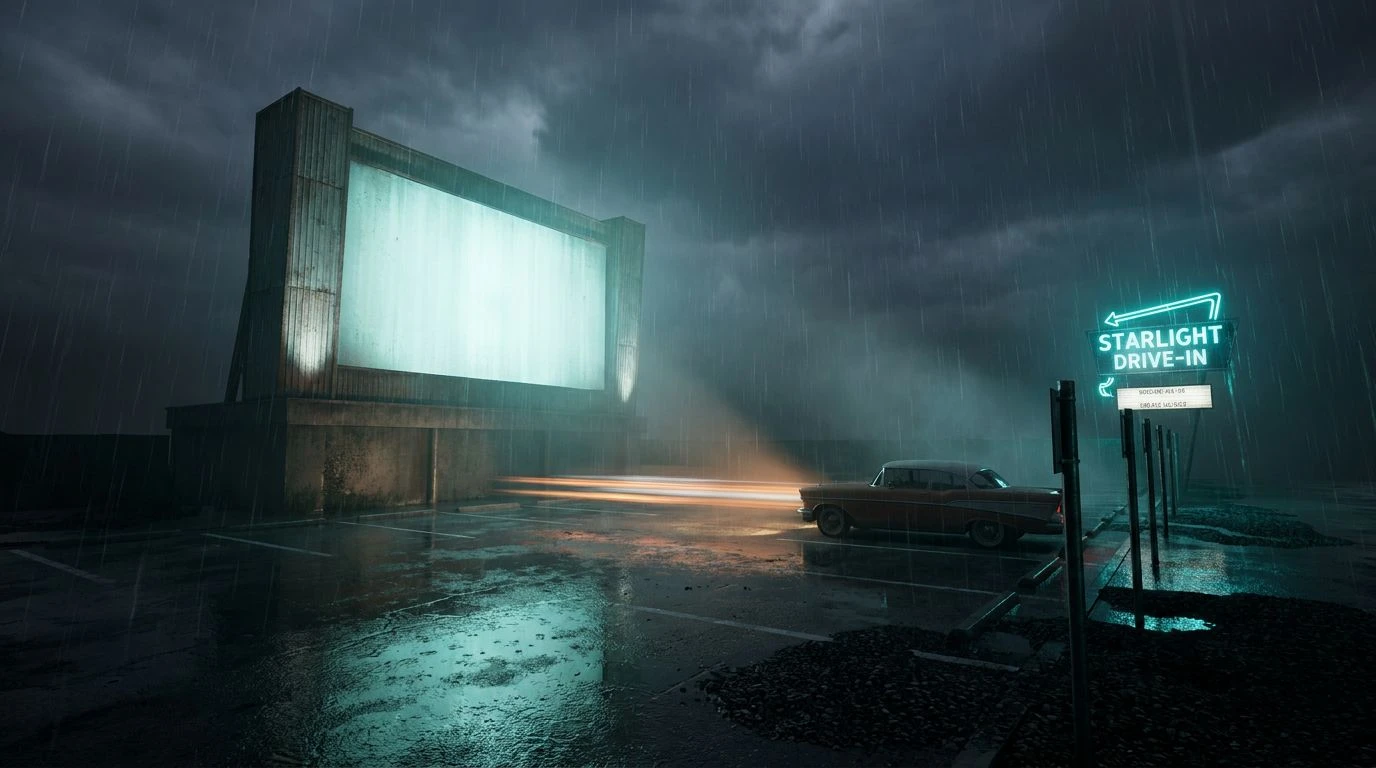
· 5 min readThere is a distinct midcentury melancholy in the image of a drive-in movie theater caught in a sudden downpour. The massive, solitary screen stands like a glowing monolith against the night sky, casting a pale, spectral light over acres of rain-slicked asphalt. This specific visual atmosphere relies heavily on the tension between deep, consuming darkness and sudden, piercing light. The colors that define this scene speak to an era of postwar optimism abruptly paused by nature. Electric blues and muted charcoals interact across a heterogeneous spectrum, where vibrant neon accents cut through shadows and heavy rain. Examining these color relationships offers a window into how visual environments construct memory and atmosphere, turning an ordinary weather event into a hauntingly cinematic experience.
Midnight Matinee 📽️
The visual narrative of an abandoned drive-in theater relies heavily on stark contrasts, a principle clearly demonstrated by Midnight Matinee. The inclusion of Screen White and Static Gray establishes the cold, rain-streaked surface of the projection screen itself, standing in direct opposition to the suffocating depth of Asphalt Black. This relationship mirrors the physical environment of a vast, empty parking lot at night. What elevates the scene from mere darkness to something memorable are the sudden strikes of color. Cyan Flash and Violet Glow act as the remaining electrical life of the space, perhaps the last flickering neon sign pointing toward the exit. These vibrant electric blue elements pierce the muted Rusted Speaker charcoal, mimicking the way projected light scatters through heavy raindrops and reflects off puddles on the ground. The resulting visual state is one of suspended animation, capturing a moment frozen in time.
Concession Stand Neon 🌭
A sudden storm forces patrons into their vehicles, leaving the auxiliary structures of the drive-in to stand alone in the rain. Concession Stand Neon captures this specific architectural isolation. The presence of Mustard Light and Tarnished Brass introduces a sudden, jarring warmth, recalling the incandescent bulbs of a snack bar shining through sheets of falling water. This artificial warmth fights against the encroaching coldness of Wet Tarmac and Raindrop Silver. The tension is further heightened by a diverse range of blues. Ticket Booth Blue and Midnight Puddle provide the ambient twilight of the storm, while Electric Surge introduces a sudden, jagged intensity reminiscent of distant lightning or a malfunctioning marquee. The varied relationships here present an environment where human comfort, represented by the yellow and gold, is steadily overpowered by the immense, dark scale of the stormy night, leaving only a ghostly mechanical glow behind.
Faded Feature 🌧️
Sitting inside a classic automobile while rain hammers the windshield creates a uniquely enclosed viewing experience. Faded Feature examines the visual spectrum seen through wet glass. The dominant presence of Gloomy Dashboard and Wipers Gray establishes the muted, claustrophobic interior of the car. Outside, the giant screen throws a washed-out, spectral light, represented by Flash of Lightning and Clouded Moon. Against these somber tones, the sudden appearance of Aqua Marquee and Periwinkle Shadow provides the electric, unnatural luminescence of midcentury cinema projection, softened and distorted by the heavy rain. The addition of Brake Light Pink introduces a critical, solitary accent. It serves as a reminder of the few remaining cars in the lot, their taillights reflecting off the soaked ground. This specific combination creates a quiet, reflective mood, focusing on the barrier between the safe, dark interior of the vehicle and the vast, cinematic storm outside.
Ghost Screen 👻
Sometimes the most striking visual statements require the strict removal of excess color. Ghost Screen strips the drive-in scene down to its most basic, haunting elements. Pure Projection and Pitch Sky form the absolute extremes of the environment, representing the bright rectangle of the movie screen completely surrounded by the void of a stormy night. Storm Cloud and Fogged Window act as the mediating atmospheric conditions, the heavy mist and rain that obscure the sharp edges of the projection. The entire environment is anchored by Periwinkle Interference, a soft yet piercing electric blue-violet that mimics the specific glow of an idling projector when the film reel runs out. This solitary burst of color against a grayscale background produces a deeply cinematic melancholy. It directs the eye to the single source of light in the wasteland, creating a visual narrative of abandonment and the lingering, spectral presence of midcentury Americana.
Rain Slicked Asphalt 💧
The ground level of a drive-in theater carries its own distinct visual weight during a heavy downpour. Rain Slicked Asphalt turns the focus downward to the flooded pavement and reflecting pools of the parking lot. Deep Puddle and Gravel Shadow set a heavy, oppressive foundation, representing the vast expanse of the wet ground absorbing the night sky. Overcast Aluminum provides the dull reflection of rain on metal speaker poles and car bumpers. Piercing this heavy, dark environment is Neon Cyan, reflecting the sharp, artificial light of the distant screen skipping across the rippling surface of the water. Accompanied by Headlight Glare, this bright blue accent cuts a sharp, jagged path through the darkness. The interaction between the oppressive charcoals and the vibrant cyan creates a cold, detached atmosphere, perfectly capturing the lonely, mechanical beauty of a flooded entertainment venue long after the audience has departed.
The visual vocabulary of a rain-soaked drive-in theater relies heavily on the stark contrast between heavy, absorbing darkness and sudden, artificial light. Examining these specific color arrangements reveals how deeply atmosphere is tied to the physical properties of light scattering through water and reflecting off dark surfaces. The interplay of deep charcoals and piercing electric blues captures the quiet melancholy of midcentury optimism weathering a storm. These environments are not merely dark or gloomy; they are defined by their solitary bursts of neon and projection light, which cut through the mist to leave a lasting, cinematic impression on the viewer. The resulting visual language speaks to isolation, memory, and the enduring physical presence of a bygone era holding its ground against the elements.