Futuristic Color Palettes for Martian Greenhouse Design
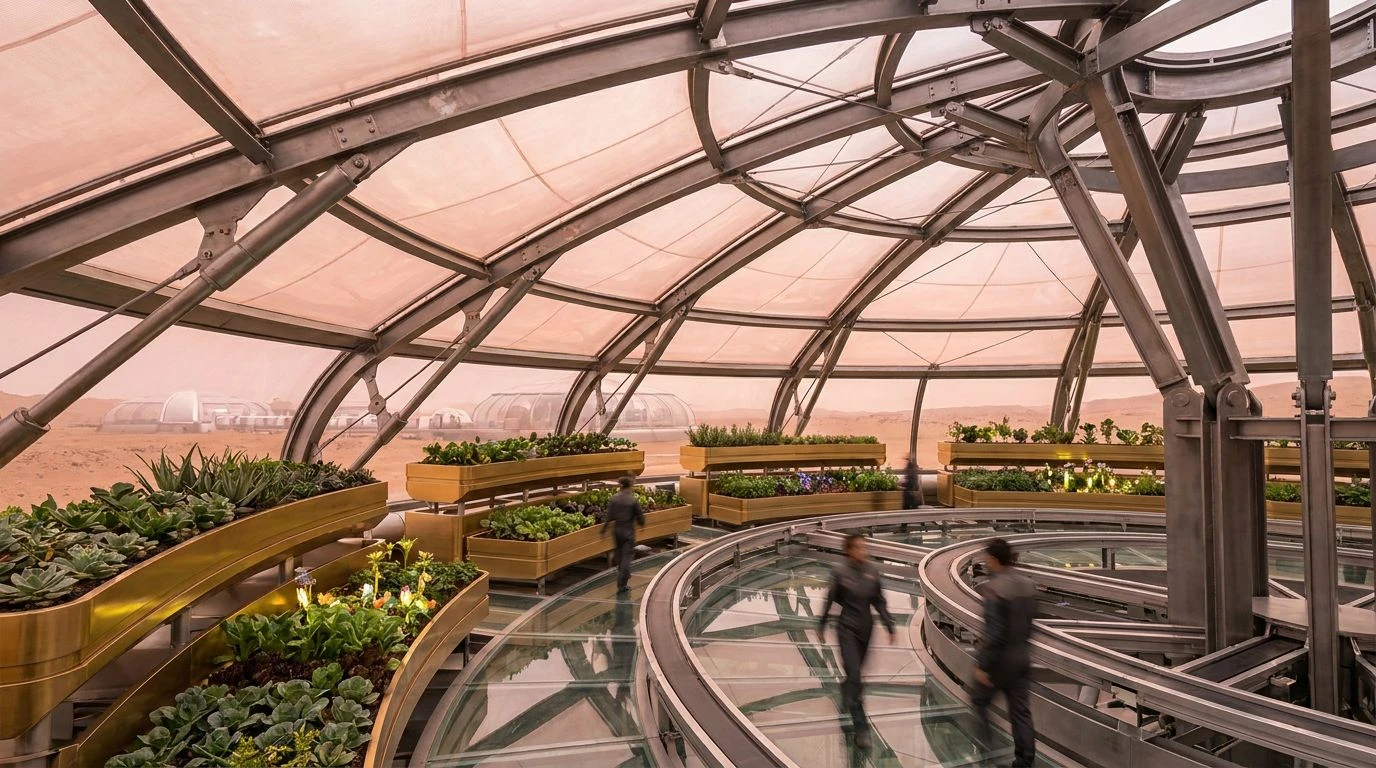
· 6 min readImagine stepping out of the harsh, rusted landscape of Mars into an enclosed agricultural habitat in the year 2080. The human eye, fatigued by endless stretches of oxidized iron, desperately craves visual stimuli that signal survival, growth, and safety. Here, the visual spectrum acts as a biological trigger. Off-world agriculture requires specific wavelengths of light to cultivate crops, but the human farmers tending these artificial biomes require their own psychological nourishment. Researchers designing these habitats have determined that pairing the cold, functional shades of industrial steel with the cheerful wavelengths of pink and yellow offers a unique perceptual balance. Pink and yellow communicate playfulness and biological vitality, counteracting the sterile isolation of deep space architecture. By painting the walls, struts, and growth trays in combinations of soft rosy hues, sunny tones, and cool grays, habitat engineers create an environment that registers to the mammalian brain as both secure and flourishing. This intersection of color perception and structural design ensures that humans can thrive emotionally while cultivating the physical food required to sustain long-term planetary outposts.
Lithic Biosphere 🌱
The visual experience of an enclosed Martian garden relies heavily on stark contrasts between the mechanical and the biological. In this particular selection of colors, Titanium Hull acts as the foundational visual anchor, mimicking the cool gray structural elements necessary to contain a breathable atmosphere. Against this industrial backdrop, Phyto-Pink emerges as a beacon of cellular reproduction. Botanists have long noted that plants grown under specific red and blue light-emitting diodes appear pink to the human eye, a visual cue that has become synonymous with high-tech agriculture. When paired with the striking Bio-Luminescent Mint, the psychological effect shifts from purely mechanical to distinctly organic. Oxidized Regolith grounds the visual field, reminding the observer of the planetary surface outside the dome, while Silica White offers high light reflectance to maximize photon efficiency for the plants. The overall perceptual effect is one of controlled, joyful cultivation, where the precision of engineering meets the chaotic exuberance of living matter.
Chlorophyll Engineering 🧪
Color in a zero-gravity or low-gravity greenhouse serves as an orienting mechanism for the visual cortex. Structural Carbon provides a deep, cool gray baseline that helps the eye delineate the physical boundaries of the planting trays and automated watering mechanisms. Against this dark, temperature-neutral background, Neon Sprout and Photosynthetic Green deliver massive bursts of visual energy. The human optical system is highly attuned to green wavelengths, historically associating them with water and caloric abundance. To prevent the environment from feeling like a sterile laboratory, the inclusion of Martian Dust Storm introduces a warm, rusted orange that connects the interior psychological space to the external geography of the planet. Vapor Condensation acts as a bright neutral, distributing ambient light evenly across the leaves. The resulting visual environment feels highly active and scientifically rigorous, yet grounded in the comforting, primitive recognition of fertile soil and vigorous plant growth.
Solar Canopies ☀️
Maintaining circadian rhythms is a major challenge for off-world colonists, making the strategic use of color essential for regulating sleep and wake cycles. Artificial Sun mimics the peak spectral output of a healthy star, delivering a bright yellow that signals daytime to the brain and encourages serotonin production. This cheerful hue works alongside Hydroponic Flow, a crisp cyan that psychologically lowers the perceived temperature of the habitat and suggests the presence of clean, circulating water. The mechanical reality of the greenhouse is communicated through the cool, metallic shades of Airlock Steel and Lunar Aluminum, which form the necessary infrastructure of the geodesic domes. By framing the bright, playful tones of yellow and cyan with these objective industrial grays, habitat designers can create spaces that feel both highly advanced and biologically welcoming. Soil Microbiome adds a deep, almost black contrast that prevents visual fatigue, giving the eye a place to rest amid the high-reflectance surfaces of the space station.
Orbital Flora 🌸
The starkness of space provides an absolute lack of light, making the artificial lighting inside an agricultural dome all the more critical for mental well-being. Void Black and Basalt Shadow serve as the architectural negative space, absorbing stray photons and giving the greenhouse a defined sense of depth and scale. Against this dark, industrial canvas, a highly playful and stimulating array of colors becomes perceptually prominent. LED Blossom introduces a delicate, biological pink that mimics the early stages of fruit development, while Photon Yellow provides a cheerful, high-visibility marker that draws the attention of human botanists to critical junctions in the hydroponic systems. Engineered Algae and Liquid Oxygen introduce vibrant secondary wavelengths that trick the mind into perceiving a lush, thriving ecosystem rather than an isolated survival pod millions of miles from home. The perceptual contrast between the cool, dark grays and the bright, candy-like colors of the plants and liquids maintains cognitive sharpness.
Yield Monitors 🌾
Visual warmth is a valuable commodity in an environment built entirely from synthetic materials and metal alloys. This particular color scheme explores the psychological comfort of yellow wavelengths set against mid-range brightness grays. Industrial Framework and Habitation Module establish a cool, metallic baseline that dominates the structural components of the greenhouse, from the air scrubbers to the pressurized doors. These grays are strictly functional, allowing the eye to process the complex geometry of the habitat without becoming overwhelmed. However, to prevent a mood of sterile confinement, Filtered Light and Harvest Gold introduce the visual equivalent of late afternoon sunshine. These yellows simulate the familiar terrestrial experience of golden hour, triggering positive psychological responses associated with ripening crops and successful harvests. Atmospheric Membrane provides a soft, hazy transition between the warm yellows and the rigid grays, ensuring the optical transition remains gentle. The result is a highly functional space that still manages to feel optimistic and fertile.
The visual engineering of an extra-terrestrial greenhouse demands far more than basic botanical survival. As we look toward the reality of farming on other planets, the psychological impact of color becomes just as crucial as oxygen and water. The strategic application of cheerful pinks and sunny yellows against the necessary backdrop of cool industrial grays prevents the human mind from succumbing to the monotony of space travel. These specific color combinations trick the optic nerve into perceiving warmth, vitality, and safety within a hostile vacuum. By studying how humans emotionally react to light and pigment, space agencies can construct off-world agricultural centers that do more than merely produce calories. They can design vibrant, playful environments that actively support the mental health of the astronauts living inside them, turning functional metal boxes into genuine sanctuaries of life and growth.