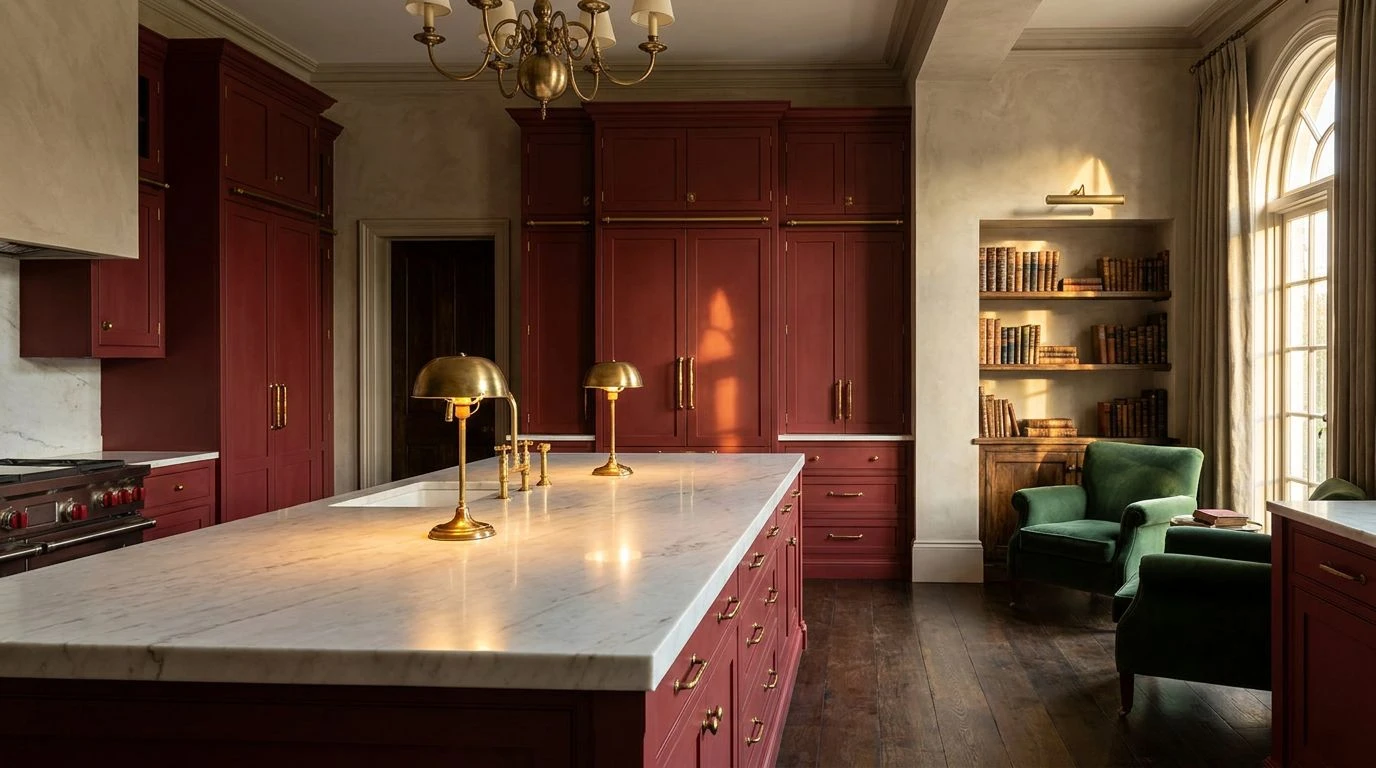
Deep Red Kitchen Color Palettes for a 1920s Library Look
· 5 min readThe modern kitchen has long suffered under the tyranny of clinical white subway tiles and sterile steel surfaces. Recently, an architectural countermovement has taken shape, steering culinary spaces away from the visual chill of a laboratory and toward the scholarly gravitas of a historic reading room. By introducing the solemnity of deep reds and the quiet warmth of aged paper tones, homeowners can grant their dining areas a profound academic weight. This approach does not sacrifice function for aesthetics; rather, it frames the daily acts of cooking and gathering as pursuits worthy of a grand, quiet dignity. A room anchored by the colors of worn leather bindings and heavy folios transforms the preparation of a meal into a deliberate, thoughtful practice, echoing the quiet concentration once reserved for the study of classic texts.
Scholar's Hearth 📚
A space grounded in Crimson Leather and Aged Vellum immediately establishes a quiet, authoritative atmosphere. When painted across custom cabinetry or applied to a heavy central island, the deep red tone demands attention without resorting to modern brightness. The inclusion of Persimmon Bound offers a slight temperature shift, acting like a bookmark placed between heavy chapters, providing a necessary jolt of visual interest near stovetops or open shelving. To prevent the room from feeling overly historic, Slate Ash and Iron Inkwell ground the design in strict utility. These darker, industrial grays mirror the raw materials of professional cookware and cast iron pans. The resulting environment feels both intellectually demanding and perfectly suited for serious culinary labor, proving that a room can prize both intellectual depth and practical cooking capabilities.
Midnight Reading Room 🕰️
Taking cues from the private desks of a century-old university, this selection relies on Ebony Shelf to provide absolute structural contrast. Against this dark, absorbing background, Sealing Wax acts as a definitive punctuation mark, ideal for a prominent enameled stove or a tiled backsplash that commands the room. Burnished Bronze and Brass Lamp introduce the metallic warmth necessary for a functioning kitchen, mimicking the hardware of heavy brass drawer pulls and overhead lighting fixtures. The unexpected addition of Banker's Lamp Green pays direct homage to early twentieth-century study halls, offering a brilliant splash of color that cuts through the heavier tones of Newspaper Print and Granite Pedestal. This environment encourages lingering conversations over late evening meals, surrounded by the quiet intensity of deep, saturated academic colors.
The Archival Pantry 📜
Moving away from high contrast, this selection offers a softer, more archival approach to the scholarly kitchen. Faded Morocco provides a muted, historical red that looks as though it has been gently aged by decades of sunlight filtering through large, dust-moted windows. Set alongside Dust Jacket Taupe, the two tones create a gentle background for dining spaces where slow, methodical cooking takes place. Marble Bust brightens the room just enough to maintain culinary safety and cleanliness, while Gilded Edge introduces a quiet metallic glint, reminiscent of gold-leaf lettering on an antique spine. Bookbinders Green finishes the room with a muted organic presence, pairing naturally with dried herbs or aged wooden cutting boards. The room becomes a retreat, a quiet corner where recipes are studied with the same care as rare historical documents.
Antiquarian Kitchen 🖋️
The atmosphere established by India Ink and Silver Letter Opener suggests a rigorous, disciplined approach to gastronomy. This is a kitchen designed for serious work, where shadows are embraced rather than banished. Worn Copper and Roasted Chestnut introduce a specific, radiating heat to the room, drawing the eye toward the center of activity, whether that is a butchery block or a heavy dining table holding a feast. These colors possess a tactile quality, calling to mind the worn leather seating of a private club or the heavy copper pots hanging from a rack. Gilded Manuscript acts as the primary source of light in this dark, academic scheme, providing a burst of bright, golden energy that keeps the room from feeling entirely closed off. It is a bold, uncompromising direction for a dining space, demanding a certain level of sophisticated restraint.
Collegiate Dining 🏛️
By pairing Foolscap White with Cast Iron Stove, this design maintains the clean, functional lines expected in contemporary culinary spaces while reaching back into the past for its emotional weight. Oxblood Spine is the defining characteristic here, an unyielding, historic red that anchors the kitchen island or lower cabinets with a sense of permanence and tradition. Patinated Brass provides the crucial bridge between the stark white walls and the heavy red foundations, offering a classic metallic finish for fixtures, faucets, and cabinet hardware. Limestone Hearth settles the design, giving the floor or countertops a cool, stony presence that recalls the quiet corridors of a collegiate library. This is the ideal treatment for a dining area that respects traditional architecture while requiring an environment capable of handling rigorous daily meal preparation.
Transitioning a kitchen from a purely functional workspace to a room rich with academic history requires a precise application of color. By adopting the serious, weighted tones of early twentieth-century libraries, homeowners establish a dining environment that honors the quiet dignity of domestic life. Deep reds provide an anchor of tradition, while the softer, aged tones of vellum and parchment soften the harsh angles of modern cabinetry. The result is a space that respects the serious nature of culinary work, offering a refuge that feels both historically significant and entirely prepared for the demands of the modern home.